Terrain System
The editable heightfield: chunked mesh and LOD, splat painting, coarse
collision, the native Terrain Editor and the .cterrain format.
Procedural generation: the Doppio Terrain Generator (C ABI v8); the legacy
terrain_pluginis documented interrain-plugin.md
Overview#
Terrain in Caffeine is an editable heightfield: data in TerrainHeightmap, rendering via
TerrainMeshBuilder + per-chunk LOD, splat painting in TerrainSplatmap. The engine does
not ship procedural generation in the core. Doppio's Terrain tab builds heightfields
with a node graph and places them through the C ABI v8; the legacy terrain_plugin remains
for the C++ host.
Separation of responsibilities: the Terrain Editor, sculpt/paint tools and .cterrain I/O
are native engine features. Procedural generation lives in Doppio's Terrain tab; the
legacy terrain_plugin keeps the C++ host version.
| Layer | Responsibility |
|---|---|
| Core | Heightmap, mesh, LOD, coarse collision, sculpt/paint, .cterrain |
| Terrain Editor (native) | Sculpt, splat paint, undo and .cterrain import/export |
| Terrain Generator (Doppio tab) | Presets, node graph, splat layers, Place in scene |
| terrain_plugin (legacy) | Node.js algorithm and heightmap import for the C++ host |
TerrainComponent#
struct TerrainComponent {
    u32 resolutionX = 257;
    u32 resolutionZ = 257;
    u32 splatResolutionScale = 2;          // splatmap is coarser than the heightmap
    f32 worldSizeX = WorldUnits::kDefaultTerrainSizeM; // metres (1 u = 1 m)
    f32 worldSizeZ = WorldUnits::kDefaultTerrainSizeM;
    f32 maxHeight = WorldUnits::kDefaultTerrainHeightM;

    u32 dataRevision = 1;                  // bumped when heights/splat change
    u32 meshRevision = 0;
    u32 splatRevision = 1;
    bool castShadows = true;
    bool receiveShadows = true;

    char texturePath[256];                 // default ground albedo
    char normalMapPath[256];               // triplanar normal map (GPU)
    f32  textureTileSize = 8.0f;
    f32  shininess = 16.0f;                // legacy; terrain shading has no specular
    Vec3 tint{1.0f, 1.0f, 1.0f};           // multiplies the sampled albedo

    bool useSplatmap = true;
    char splatLayerPaths[4][256];          // Grass, Rock, Sand, Dirt defaults
    f32  splatTileSize = 8.0f;

    bool useChunks = true;
    u32 chunkVertexCount = 33;
    u32 maxLodLevels = 2;
    bool frustumCull = true;
    f32 lodDistanceScale = 520.0f;
    f32 lodHysteresis = 0.25f;

    u32 collisionSampleStep = 4;           // 4 = ~16x fewer triangles
    bool buildCollisionMesh = true;

    char terrainDataPath[256];             // .cterrain path in the project
};
The internal heightmap stores normalised values [0, 1]. In the mesh, y = sample * maxHeight.
Data pipeline#
TerrainComponent (ECS)▼TerrainCache::initializeEntity / syncEntityTerrainHeightmap (CPU, editable)TerrainSplatmap (4 layers)Mesh3D render (TerrainMeshBuilder + tangents)Mesh3D collision (TerrainCollisionMeshBuilder, decimated)TerrainChunk[] (LOD + frustum cull)
TerrainMeshBuilder#
- Generates vertices with the heightmap normal (
sampleNormalBilinear). - UVs tiled according to
textureTileSize/splatTileSize. - Tangents calculated per triangle (base for normal mapping).
Collision#
TerrainCollisionMeshBuilder reuses buildRegion with collisionSampleStep (for example 4 →
~16× fewer triangles). Access it through TerrainCache::collisionMeshFor(entity).
Editor#
| Panel | Function |
|---|---|
| Inspector → Terrain | Resolution, size, LOD, splat, collision, Normal Map, Shininess |
| Terrain Editor (native) | Sculpt (raise/lower/smooth/flatten/noise), splat paint, import/export .cterrain |
Native Terrain Editor#
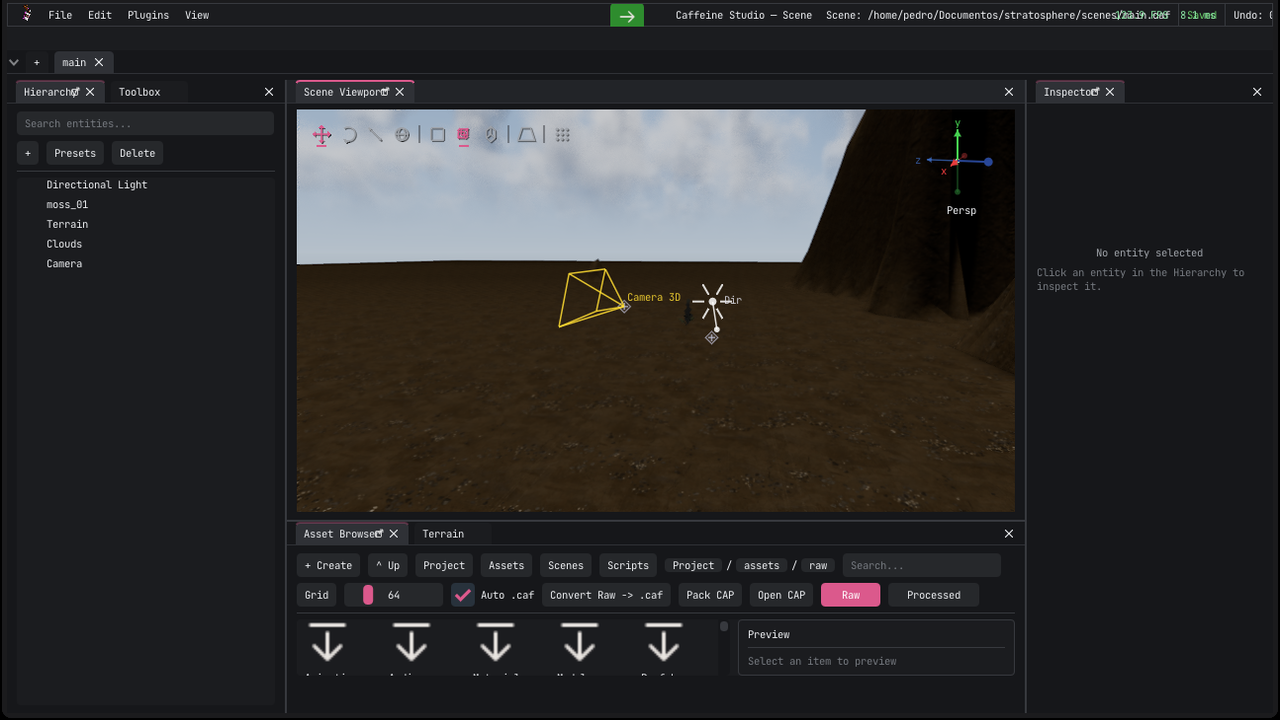
Open it from View → Terrain Editor, the command palette (Terrain Editor), or the Open Terrain Editor button in the Toolbox while a Terrain entity is selected.
| Tool | Behaviour |
|---|---|
| Raise / Lower | Adds or removes height with a smooth falloff |
| Smooth | Averages the local neighbourhood |
| Flatten | Flattens to the height under the first click of the stroke |
| Noise | Adds deterministic detail |
| Splat paint | Paints Grass, Rock, Sand or Dirt weights |
| Reset default textures | Restores the default paths and the Grass layer |
| Data tab | Edits the .cterrain path and imports/exports the file |
Fast strokes are interpolated between frames instead of stamping only once per frame. Undo/redo snapshots include the heightmap and splatmap, so Ctrl+Z restores terrain edits instead of resetting the terrain to flat.
New terrains start with the Grass layer and natural 1k ground textures
from assets/hdr-assets-texture (dirt/rock/moss, rocks, dirt and mud). The
Inspector Tint colour multiplies the sampled albedo.
Scenes authored before this default stored an unpainted terrain as the old
Light layer. Loading such a .cterrain migrates the uniform Light splatmap
to Grass and upgrades the untouched Kenney prototype paths to the natural ground
set automatically.
Procedural generation: panel Terrain Generator (plugin). The plugin does not own sculpting or painting.
GPU rendering#
With CF_HAS_SDL3, terrain uses terrain_lit.frag:
- Lambert diffuse plus sky IBL; the surface is a rough dielectric, with no specular lobe.
- Normal map triplanar via the terrain GPU texture cache (sampler slot 5).
- Directional shadows (slots 6–7), point cubemaps (slots 8–9) and spot maps (slots 10–11).
- Splat map on slot 0, the four layers on slots 1–4.
castShadows/receiveShadowsare read inGpuSceneRenderer::gatherMeshDraws.
See rendering/materials-phong.md and
rendering/shadow-mapping.md.
Serialization#
SceneSerializer writes TerrainComponent into the scene blob (terrain blob version 11).
Version 9 added collisionSampleStep and buildCollisionMesh; version 10 added
normalMapPath and shininess; version 11 added tint. Legacy generation fields (v2–v8) are
read and discarded for compatibility. Heavy height/splat data live in the .cterrain
referenced by terrainDataPath.
Useful API#
TerrainCache& cache = TerrainCache::instance();
cache.initializeEntity(world, entity);
cache.heightmapFor(entity)->setNormalized(x, z, h);
cache.syncEntity(world, entity);

Terrain::importHeightmapFile(world, entity, path, worldSizeX, worldSizeZ);